|
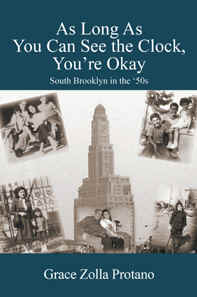 In
Grace Zolla Protano's memoir we meet the people who most impacted
her life: her brothers Jack and Sal, who gave her strength and
laughter; her father Anthony, who showed her gentleness and
character. We see her mother Fiorentina, who taught her kindness
and wonder, but whose emotionally crippling illness stole half a
childhood. In
Grace Zolla Protano's memoir we meet the people who most impacted
her life: her brothers Jack and Sal, who gave her strength and
laughter; her father Anthony, who showed her gentleness and
character. We see her mother Fiorentina, who taught her kindness
and wonder, but whose emotionally crippling illness stole half a
childhood.
Set mainly in Brooklyn in the 1950s, As Long As You Can See the
Clock, You're Okay is a recollection of growing up with a unique
love embodying joy and sadness; pride and shame; tenderness and
cruelty.
We sing along with the doo-woppers; we drool over the teen idols
as we cheer throughout Alan Freed's Rock and Roll Revue at the
Brooklyn Paramount Theater. We play Ringo Levio, Kick the Can and
Iron Tag until our moms look out their windows and call us in.
The author longs for her absent mother and we cry with her; she
feels a safety just by seeing Downtown Brooklyn's 512 foot icon,
the Williamsburgh Savings Bank clock tower, and we understand
fully why As Long As You Can See the Clock, You're Okay.
|
EXCERPTS
FROM AS LONG AS YOU CAN SEE THE CLOCK, YOU'RE OKAY
"There he is, there he is," we shrieked as one piercing
voice.
Alan Freed walked out onto the stage and stood in front of the
sixty-foot curtain decorated with satin-embroidered pheasants. The
audience of wild teens, crazed with expectation, stood in unison
and exploded. He smiled and waited for the ovation to settle down.
Though our seats were near the back, we could still see the
distinct features that so distinguished the man--short-cropped
curly hair, full-nostrilled nose that stretched even wider when he
smiled. His small dark eyes and thin build transformed into a
statuesque Greek god who could mesmerize.
* * * *
We had no television in the early Fifties, so our wooden Philco
floor radio was our entertainment.
"Hurry up, Gracie, set the table," Mom said. "Luigi
is coming on in ten minutes."
Dinnertime on Tuesday nights meant Life with Luigi. And nobody
talked at dinner unless it was during a commercial break. Dad sat
at the head of the table, I at the foot--I liked to think he was
at the foot and I was at the head, my brothers Jack and Sal along
the left side of the table, Mom opposite them.
* * * *
It was an ivory-colored village. The houses were made of polished
pearlized marble, the curtains a snowy velvet, the carpeting cream
plush. The lawn looked like white angora strips of yarn with
swan-feathered bushes.
"It's so white and so quiet here, Mom. Aren't you
afraid?"
* * * *
There was a sorrow to this structure. In each section of damaged
stucco, there was a longing to be replaced or at least repaired.
In my mind, on one level there was a curious strength to the
crumbling outer wall, as though it wanted to prolong its total
disintegration. On another level, it was just a house with a
broken heart. |
|